

Powder-coated steel has been the default answer to toilet partitions for decades, and in a lot of facilities, it still does the job. But the types of toilet partitions specified on new commercial projects have shifted. Facility owners, architects, and general contractors are increasingly reaching for phenolic, HDPE, compact laminate, and plastic laminate instead of steel, and for good reason. Holman, Inc. has installed all of the above across Jacksonville-area schools, offices, and healthcare facilities, and the material conversation with clients looks different than it did even five years ago.
This isn’t a case of steel becoming obsolete overnight. It’s a case of facility managers having more options, and better information about which option actually fits their space.
Why Facilities Are Reconsidering Steel Toilet Partitions
Powder-coated steel partitions are affordable and familiar, but they have a well-known weak point: moisture. In a high-humidity restroom environment, coated steel is vulnerable to rust and corrosion at the seams, edges, and mounting points over time. Once that starts, the partition looks worn well before it’s actually failed structurally, and repairs are rarely as clean as a fresh install.
That single issue, more than any trend, is what’s driving facility owners to ask what other types of toilet partitions are available and whether one of them solves the moisture problem for good.
Phenolic Toilet Partitions: Built for Wet, High-Traffic Spaces
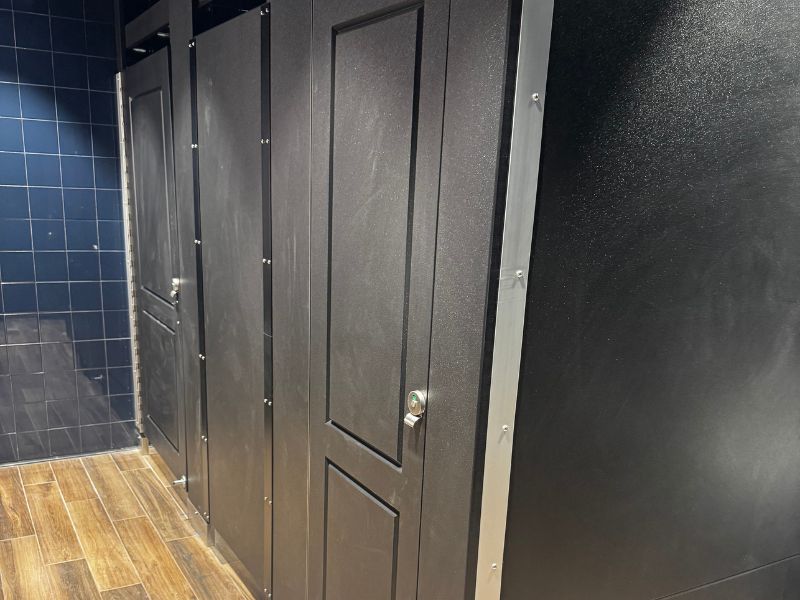
Phenolic partitions come in two main constructions. Color-through phenolic is a single material fused under heat and pressure, with color running through the entire panel rather than sitting on the surface. Whereas, the more commonly used version of phenolic partitions has a black phenolic core with a laminate finish applied to the front and back faces. This gives it a more finished, upscale look while keeping the same moisture resistance at its core.
Best fit for: Higher-end office buildings and other wet-area spaces, like locker rooms or upscale amenity restrooms, where the material needs to hold up to moisture but still look polished.
HDPE Partitions: Durable and Low-Maintenance
High-density polyethylene, or HDPE, partitions are solid plastic panels that are naturally water-resistant, don’t rust, and hold up well to graffiti and heavy cleaning chemicals. They’re a common choice in schools, city parks, and other high-traffic public restrooms that need a heavy-duty material more than a polished look.
Best fit for: Schools, public-facing restrooms, parks and recreation facilities, and any space where partitions need to withstand frequent cleaning without degrading.
Plastic Laminate: A Budget-Friendly, Dry-Area Option
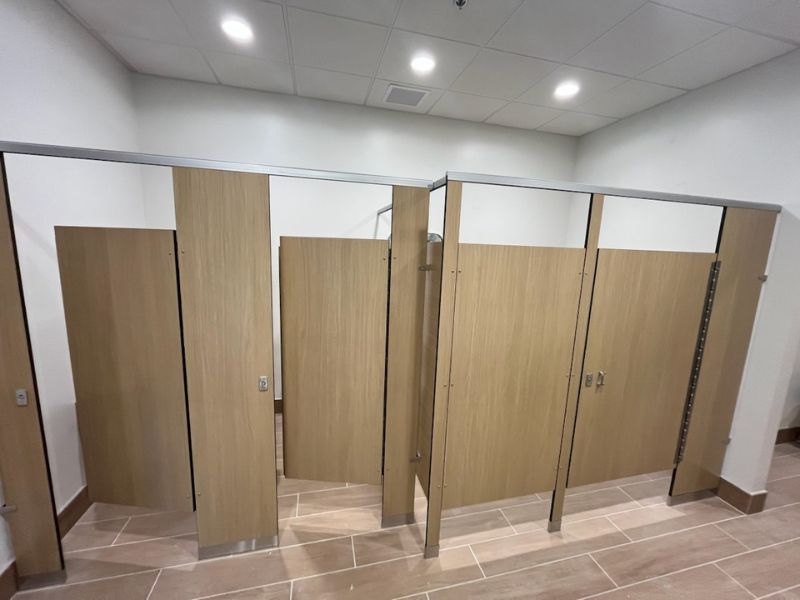
Plastic laminate partitions are built on a particleboard or MDF core with a laminate sheet applied to the surface for the finish. Because the core is a wood product, plastic laminate holds up well in dry conditions, but it isn’t a good fit anywhere moisture is a regular factor, since the core can swell or delaminate if it gets wet. What plastic laminate does offer is an upfront cost similar to powder-coated steel, along with a wider range of finish options than nearly any other material, since any laminate pattern can be applied to the surface.
Best fit for: Dry-area restrooms in offices or other low-moisture spaces where budget and finish variety matter more than moisture resistance.
Antimicrobial Finishes: The Newer Consideration
A more recent development across all of these types of toilet partitions is the addition of antimicrobial finishes, treatments built into the material that inhibit the growth of bacteria, mold, and mildew on the surface. This isn’t a replacement for regular cleaning, but it’s a meaningful addition in facilities where infection control is a priority, such as healthcare settings and schools.
The Centers for Disease Control and Prevention has published guidance on how surface materials factor into environmental infection control, and antimicrobial finishes are increasingly part of that conversation for commercial facilities, not just hospitals.
So When Do Steel Partitions Still Make Sense?
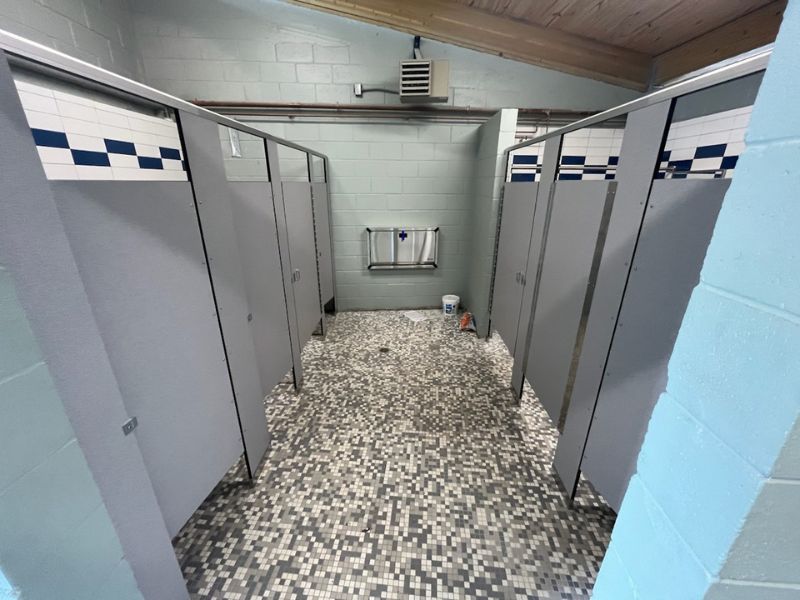
Powder-coated steel isn’t gone from the conversation, and it shouldn’t be. It’s still one of the more budget-friendly types of toilet partitions available, and in lower-moisture, lower-traffic environments, such as a small office restroom used by a handful of employees, it can perform perfectly well for years. The decision isn’t steel versus everything else. It’s matching the material to how the space actually gets used.
That’s also where a lot of facility owners get it wrong: choosing a partition material based on upfront cost alone, without factoring in how much moisture, traffic, or cleaning chemical exposure the space will see over its lifespan. A phenolic or HDPE partition costs more on day one, but durable, longer-lasting building materials, including recyclable plastics like HDPE, can reduce long-term replacement and waste costs even when the upfront investment is higher.
Comparing the Options at a Glance
For a quick reference point, here’s roughly how the four most common types of toilet partitions stack up on the factors facility owners care about most:
- Powder-coated steel: Lowest upfront cost, but the most vulnerable to moisture and corrosion over time.
- Phenolic: Higher upfront cost, but among the most moisture- and impact-resistant options available, which makes it a strong long-term value in wet, high-traffic spaces.
- HDPE: Similar durability profile to phenolic, with strong resistance to graffiti and harsh cleaning chemicals, making it a common choice for public and park facilities.
- Plastic laminate: Priced close to steel with the widest range of finish options, but limited to dry-area restrooms because of its particleboard core.
None of these are the “right” answer in every situation. They’re four legitimate options, and the right one depends on what a specific restroom actually needs to hold up to.
Making the Right Call for Your Facility
With several types of toilet partitions now available, the right choice comes down to a short list of practical questions: How much moisture will the space see? How much daily traffic and cleaning does it get? Does the restroom need to match a broader design standard? And is infection control a priority for the people using it?
Holman, Inc. has spent more than 20 years helping Jacksonville-area facility owners, architects, and general contractors work through exactly these questions before a partition order goes in, not after an install starts showing wear. Our team can walk through toilet partition material options based on the specific conditions of your space, not a one-size-fits-all recommendation.
Not sure which partition material is right for your next project? Contact us today about your restroom upgrade or new build.
