
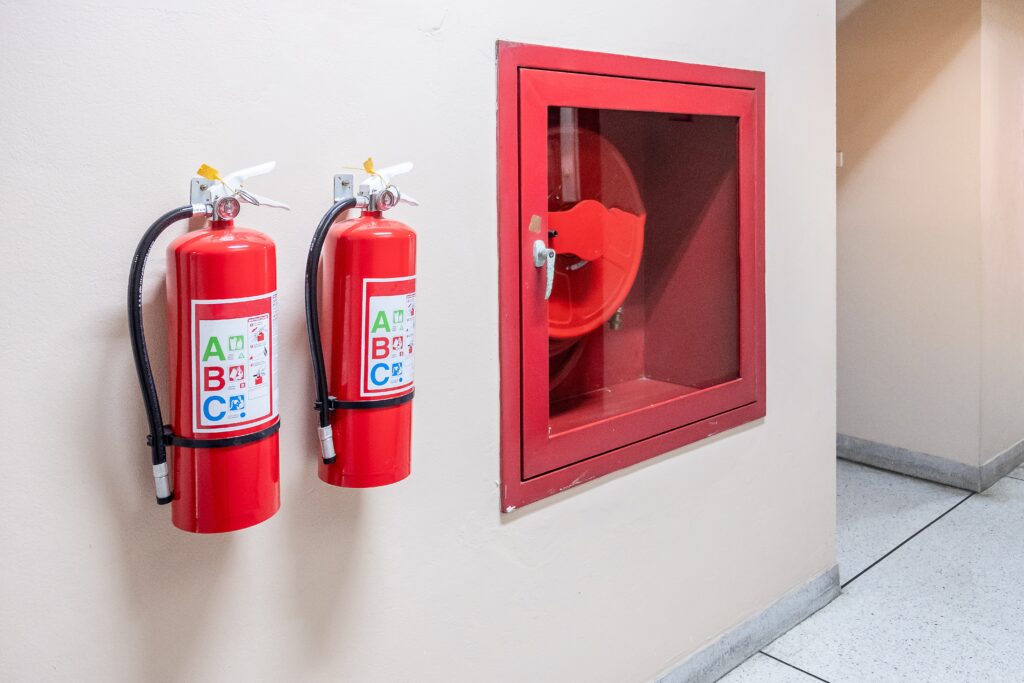
Fire extinguishers are something no business can be without. These canisters are essential fire safety products that protect properties from fire damage. What many people might not realize is that not all fire extinguishers are the same. There are different types of fire extinguishers that use different materials to put out fires. You can’t just use any fire extinguisher for any fire. If you are a building or business owner, you need to understand the differences between the different types of fire extinguishers to ensure fire safety on your property.
Key Takeaways: Different Types of Fire Extinguishers
- Dry chemical, wet chemical, Halotron, and pressurized water fire extinguishers all use different agents to extinguish fires of different classes.
- Other types of fire extinguishers to keep in mind include dry powder fire extinguishers, carbon dioxide fire extinguishers, and foam fire extinguishers.
- Make sure you have the right fire extinguisher type for the specific fire hazards that are relevant to your place of business.
- Holman Inc. can help you choose the right fire extinguisher to protect your business.
- Holman Inc. carries a full range of fire equipment, including all the extinguisher types covered below, to protect your business.
What are Different Types of Fire Extinguishers?
The main difference between the different types of fire extinguishers can be found in the different agents each fire extinguisher uses for different fires.
| Fire Extinguisher Type | Fire Class | Applications |
| Dry Chemical | A, B, and C | Uses a fine powder to put out fires from solid combustibles, flammable liquids, and electrical fires. |
| Wet Chemical | K | Uses a potassium-based liquid solution to turn hot oils from cooking fires into soapy foams. |
| Halotron | A, B, and C | HCFC gas blend that diffuses the chemical reaction of the fire without conducting electricity, making it a great choice for fires present near electronics. |
| Pressurized Water | A | Water with pressurized air that cools burning materials from solid combustibles only. |
Dry Chemical Fire Extinguishers
Dry chemical fire extinguishers use a fine powder to put out fires in homes, offices, industrial facilities, and warehouses. This powder coats fires and removes their oxygen, choking them out. Dry chemical fire extinguishers are best used for Class A fires (solid combustibles), Class B fires (flammable liquids), and Class C fires (electrical). The one disadvantage of dry chemical fire extinguishers is that it leaves behind residue that is hard to clean up.
Wet Chemical Fire Extinguishers
Wet chemical fire extinguishers put out fires using a potassium-based liquid solution that causes a chemical reaction which turns hot oils into soapy foam that dissolves. There’s also no residue left behind to clean up. Keep a wet chemical fire extinguisher in kitchens that use grills, stoves, or deep fryers as they are specifically rated for Class K fires involving cooking oils and fats. Using water on a kitchen fire is a bad idea because mixing water with hot grease can cause an explosion. Be sure to use wet chemical fire extinguishers instead in the kitchen. Be careful, however, not to use wet chemical fire extinguishers on Class C electrical fires because the liquid solution it uses conducts electricity.
Halotron Fire Extinguishers
Halotron is a clean agent, meaning it doesn’t leave powder or foam behind after discharging. Halotron fire extinguishers discharge a rapidly evaporating gas blend to stop the chemical reaction that fuels fires. Since it leaves no residue, this is the perfect fire extinguisher to use around electronics in cases of Class A (combustibles), Class B (flammable liquids), or Class C (electrical) fires. This is why you see Halotron fire extinguishers on airplanes and in labs and data centers. Because it leaves no residue, however, Halotron fire extinguishers are typically more expensive than others.
Pressurized Water Fire Extinguishers
As you may have guessed, the agent in pressurized water is water pressurized with air. These kinds of fire extinguishers can be used with Class A fires only because water can ignite and spread flammable liquids and can conduct electricity during electrical fires. Use pressurized water fire extinguishers to cool burning wood, paper, cloth, or trash. Pressurized water fire extinguishers are a good choice to use in schools or offices, but they should never be used for Class B flammable liquid fires or Class C electrical fires.
Other Types of Fire Extinguishers
Additional fire extinguishers that are effective at smothering and putting out fires include dry powder fire extinguishers, carbon dioxide fire extinguishers, and foam fire extinguishers. The powder used in dry powder fire extinguishers breaks up the chemical reaction between fuel and oxygen, which smothers the fire. This makes dry powder a good choice for Class D fires, which involve combustible metals. Carbon dioxide fire extinguishers remove oxygen altogether, replacing it with pressurized carbon dioxide gas. They also leave no residue behind. This is good for protecting electronic equipment in areas like laboratories or data centers. However, a carbon dioxide fire extinguisher is not recommended for outdoor use or for indoor locations with strong air currents because it can dissipate quickly. Stick to using this kind of fire extinguisher for Class B and Class C fires. Finally, foam fire extinguishers cover fires like a blanket with a thick layer of film to snuff them out by removing their oxygen. Because foam contains water, it won’t be effective in freezing temperatures or on electrical fires, but it can be used for Class A and Class B fires.
Choosing the Right Fire Extinguisher for Your Business
Picking the right fire extinguisher for your business depends on the size of your location and the specific fire hazards found inside. You need to know which class of fires are most likely to happen in this location and which fire extinguishers would be best to combat them. For example, if your business is just a small office, it would be best to just have a default dry chemical fire extinguisher for Class A, B, and C fires. However, if your business includes a server room with many electronics, a Halotron fire extinguisher or carbon dioxide fire extinguisher would work far better. If you run a restaurant with a large kitchen, make sure you have a wet chemical fire extinguisher for Class K cooking fires.
Is Your Business Prepared for Fire Hazards?
To be truly prepared to handle fire hazards, your business needs to have the right fire extinguisher for the fire risks that are specific to your business. There are different types of fire extinguishers that can each handle different types of fire risks. Dry chemical, wet chemical, Halotron, and pressurized water fire extinguishers all use different agents for different types of fires. Fire extinguishers work best as part of a complete fire safety plan that also includes features like fire rated commercial doors, which help contain flames and smoke so people can evacuate safely. They each have their own advantages and disadvantages, but they each work to put out different classes of fires. If you need help choosing the right fire extinguisher for your business, contact Holman Inc. We can help you learn more about fire extinguishers and help you find the right fire equipment for your commercial business in the Jacksonville area.
Different Types of Fire Extinguishers: FAQs
Class ABC fire extinguishers are known for having a dry chemical powder that coats fires and removes their oxygen.
PASS is an acronym for how to use a fire extinguisher created by OSHA. The four steps of PASS are:
- Pull
- Aim
- Squeeze
- Sweep
To successfully utilize the PASS method, you pull the safety pin at the top of the fire extinguisher to unlock the handle, aim the hose or nozzle low at the base of the fire, squeeze the handle to release the extinguishing agent, and sweep the nozzle from side to side until the fire is put out.
Class K fire extinguishers are necessary for commercial kitchens and food preparation areas that utilize fryers or solid fuel cooking appliances as these kinds of equipment are susceptible to fires involving grease, fats, or cooking oils. Hot oils can cause cooking fires that can only be put out by the potassium-based liquid solution found in Class K fire extinguishers.
While Class D fire extinguishers are designed to address fires involving combustible metals or metallic alloys, you should NOT use a Class D fire extinguisher to put out automobile fires or fires involving lithium-ion batteries. Class D fire extinguishers do not have the capability of putting out a large car fire that is too hot for a fire extinguisher of this kind. Also, lithium-ion batteries require a specialized water/blanket approach to be put out. A Class D fire extinguisher is not ideal for fires involving cell phones or electric vehicles.
