
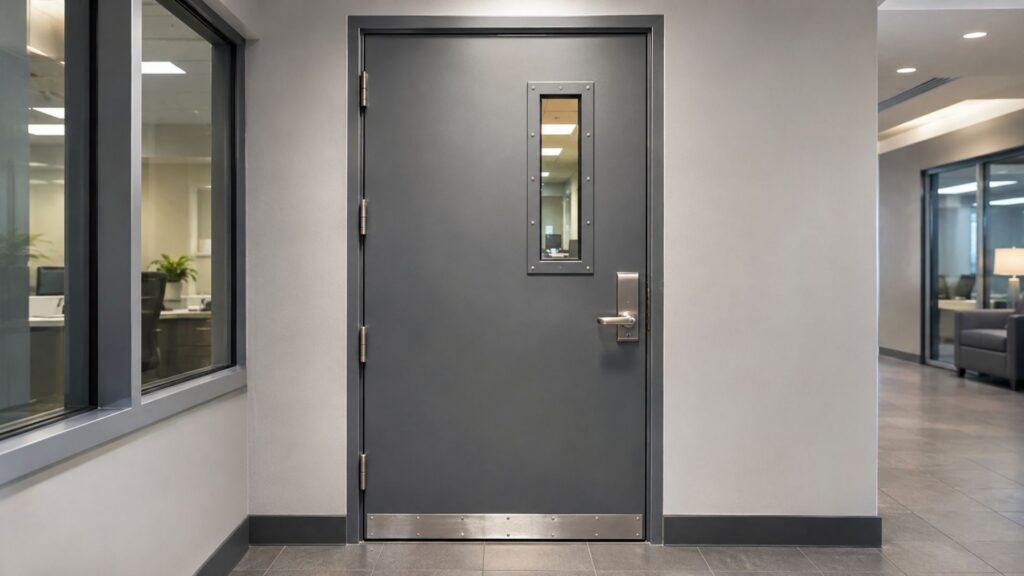
Safety is always at the forefront of your mind when you own a commercial business. Investing in safety features is never a bad idea for your business. Some business owners have more extensive safety needs than others. For instance, some business owners see the benefit of purchasing and installing bullet resistant doors. These doors provide the strength and security you want to stop intruders and prevent harm to your customers and employees. If you’re curious about bullet resistant doors, you can learn about the different types of these doors available, as well as how to choose the right door for a commercial building. Holman, Inc. can introduce you to bullet resistant doors for your commercial property in the Jacksonville, FL area.
Key Takeaways: Bullet Resistant Doors
- Bullet-resistant doors keep bullets from penetrating doors with a multi-layered composite core that absorbs these bullets and their kinetic energy.
- Bullet-resistant doors are necessary for a number of different vulnerable businesses with valuable items or sensitive information.
- Bullet-resistant doors are built differently from regular doors, using multiple layers of ballistic-resistant material.
- Bullet-resistant doors are tested under UL 752 North American Standards for different levels of strength and resistance
What are Bullet Resistant Doors?
Bullet resistant doors are engineered specifically to resist the penetration of bullets using multi-layered composite cores. Specialized materials are used in the assembly of these doors to enhance their protective performance. These materials include ballistic-rated steel, reinforced composites, or other tested ballistic-resistant panels. What these materials do is absorb gunfire and redirect its kinetic energy, keeping it from penetrating through the door to the other side.
Typical commercial doors are designed to prevent physical entry into a room, providing general security for a commercial property. The materials used in a commercial security door are designed to resist forced entry. However, these doors are not designed specifically to stop bullets. Even though most commercial security doors are made of steel, they are not automatically bullet resistant. A bullet-resistant door has layers of ballistic steel and fiberglass, giving it a thicker profile. This thickness helps redirect ballistic impacts, such as those from handguns and rifles.
The unique security concerns of many different businesses draw them to invest in bullet-resistant doors. Bullet-resistant doors are used commonly at the following businesses:
Government buildings
Government buildings need a comprehensive security strategy to protect employees, visitors, sensitive information, and critical operations. With that in mind, many government buildings have bullet-resistant doors that resist bullet penetration and reduce the risk of injury to those on the other side of these doors. Not only do these doors stop attackers, they also prevent the breaching of restricted areas where unauthorized access would pose significant security and safety threats.
Banks

Banks are always at risk of robbery. These businesses are attractive to robbers because they hold plenty of cash and other valuable assets. Most banks will try to prevent armed threats to these assets by installing bullet-resistant doors in critical areas such as teller stations and cash-handling rooms. Bullet-resistant doors also help keep burglars out of vault access points and restricted employee areas. Bullet-resistant doors can help delay an attacker and provide additional time for employees and law enforcement to respond to a bank robbery.
Schools

Perhaps no building is more important to protect than a school full of children. Unfortunately, intruder incidents at schools – including mass shootings – happen far too often. Bullet-resistant doors are becoming more commonplace at schools across the country in response to these mass casualty incidents. Bullet-resistant doors are just another layer of security schools have installed to protect students, as well as teachers, staff, and visitors inside the school. The design of bullet-resistant doors helps keep bullets from penetrating doors and entering classrooms or other areas where students might be.
They also help slow down intruders and allow police and other first responders time to reach the scene.
Courthouses
Courthouses are often targets of armed attacks. The sensitive nature of court cases can lead to high-profile threats and violent incidents. For that reason, bullet-resistant doors that prevent the penetration of bullets into courtrooms or judges’ chambers can help stop intruders and protect everyone inside the courthouse.
Data Centers

Data centers are home to sensitive data and critical infrastructure, so securing them is essential. Armed intruders may try to steal this data or harm this infrastructure, which is why reinforced doors are often used in data centers to keep threats out. Bullet-resistant doors built with dense layers of ballistic steel and fiberglass absorb the energy of high-velocity projectiles, keeping bullets from passing through the door.
Healthcare Facilities
The concern over active shooter and forced-entry incidents at medical facilities has increased in recent years. For this reason, many healthcare facilities are turning to bullet-resistant doors to protect staff, patients, and visitors. Bullet-resistant doors are engineered with layered materials like steel, fiberglass, and reinforced composite cores. They are then installed in high-risk areas for violent threats, including emergency rooms, pharmacies, triage desks, and behavioral health units.
High-Security Commercial Buildings
Many commercial facilities need bullet-resistant doors to stop gunfire and fortify high-risk areas from forced entry. The facilities are home to sensitive data and highly sought-after materials that would be of value to criminals. There’s also more risk now of active shooter incidents from disgruntled workers or customers. These bullet-resistant doors act as a deterrent to violent threats.
What Makes a Door Bullet Proof?
Bullet-resistant doors are not built the same as regular doors. These doors feature layered engineering designed to absorb and trap the kinetic energy of a projectile like a bullet. While some doors rely on overall thickness to deter threats, bullet-resistant doors have core materials and an internal structure that are designed to create a barrier against projectiles. Bullet-resistant doors feature several different main components that all work together to contribute to ballistic resistance. These components include:
- Door core: The inner ballistic core of your door is perhaps the most important feature of a bullet-resistant door. The core of these doors features multiple layers of materials to capture bullets and disperse the energy and pressure they provide.
- Steel: Stopping a projectile requires more than just a thick layer, and steel plays a major role. Ballistic-grade steel deflects or shatters bullets, and together with the door’s other protective materials, it absorbs a bullet’s kinetic energy and limits its ability to penetrate the door.
- Door frame: Ballistic-rated frames provide continuous coverage across the clearance gap between the edge of the door and the frame. The frame also helps prevent sagging and misalignment, and it anchors the door against forced entry and bullet impacts.
- Hardware: Hardware is an essential part of a bullet-resistant door. The door’s hardware plays a major role in the entire function of these ballistic doors, helping to keep them locked and attached to the frame. This is extremely important to ensuring security anywhere that has a bullet-resistant door.
- Locks: A ballistic-rated lock helps keep an intruder from shooting through the lock to bypass the door. Its heavy-duty locking mechanism is designed to withstand gunfire so the door stays secured.
- Hinges: The hinges of a bullet-resistant door run the entire vertical length of the door. What this does is make it hard to penetrate the gap between the door and the door frame. These hinges seal off the gap and prevent attackers from shooting in between the door and the frame.
- Vision panels: Yes, bullet-resistant doors can also have some transparency with a window of their own. Vision panels utilize glass-clad polycarbonate with multi-ply ballistic glazing to provide a strengthened outer glass layer with an acrylic interlayer behind the glass. The hard-coated polycarbonate traps internal fragments as a result of someone shooting into the glass. You can trust vision panels to prevent glass from being shattered into pieces when shot into.
What are the Different Types of Bullet Resistant Doors & How Strong Are They?
Bullet-resistant doors feature ballistic cores made up of metal, wood, or composite materials that are all tested under UL 752 North American standards to turn away firearm rounds and prevent fragments from flying around everywhere once they are hit. UL 752 standards list different levels for bullet-resisting performance. These different types of bullet-resistant doors are as follows:
Levels 1-3
UL 752 performance levels 1-3 are designed for handgun protection. These doors are designed to resist bullets from small- to high-caliber handguns, making them ideal for convenience stores, gas stations, pharmacies, and banks.
Levels 4-8
Performance levels 4-5 include bullet-resistant doors designed to stop high-velocity single-shot rifles. Police and government buildings often utilize these doors for protection. Levels 6-8 stop multi-shot handguns and high-powered military rifles. These are the kinds of doors you see at military bases and embassies.
Levels 9-10
UL752 levels 9 and 10 are the highest levels of ballistic protection that have been tested. They are designed to defend against military-grade projectiles such as armor-piercing rifles and heavy sniper fire. These doors are designed specifically for military use in bases, guard towers, checkpoints, and defense facilities.
Custom bullet resistant door systems
These are doors you cannot just buy anywhere; they are custom engineered to defend your property from more than just bullets. They also protect from forced entry, explosions, and hostile intrusions. These doors can be custom configured to match the design of your building while still providing specialized hardware and components to prevent bullets from blasting through or slipping by structural gaps.
How Much Do Bullet Resistant Doors Cost?
Most bullet-resistant doors are sold between $4,000 and $6,000, according to door retailers. It’s important to remember that different materials and levels of protection will play a role in determining that final cost. For example, an acrylic door can cost around $3,000, while a frameless glass door might cost you up to $10,000. Aluminum and glass doors will cost you more than steel or wood doors. The highest-grade, militarized bullet-resistant doors may cost $20,000 or more.
You can find bullet-resistant doors from Holman, Inc. We have a huge selection of interior commercial doors, including security doors for highly targeted facilities like banks, data centers, and government buildings. We handle door and hardware installation, including framing and prep work. Whatever level you choose, security doors still have to meet accessibility rules, so review ADA door requirements in Florida before you specify hardware and clearances.
Contact us for commercial door installation across Jacksonville and throughout Northeast Florida. You can count on our team for quality commercial door installation for your school, healthcare facility, office park, or other commercial buildings.
Bullet Resistant Doors: FAQs
The different levels of bullet proof refer to the UL 752 standards for building materials, windows, and doors. The level increases as the capacity of the weapon these materials can defend against increases. Levels 1-3 refer to bullet resistance against handguns, while levels 4-8 are for rifle and machine gun threats. Levels 9-10 are for heavy/specialized threats.
The lifespan of bullet proof glass can vary depending on materials, but the typical lifespan is 15 to 25 years.
The businesses that most need bullet proof doors are those that handle high-value assets or house critical infrastructure. Public, educational, and healthcare facilities are also susceptible to intruders, making it necessary for them to have bullet proof doors. Examples of businesses that need bullet proof doors include jewelry stores, pawn shops, convenience stores, banks, data centers, utility and energy facilities, schools, pharmacies, and hospitals.
No, these doors are not absolute. There’s no such thing as unlimited protection when it comes to someone firing a gun. Even these high-security doors are susceptible to conditions beyond what they have been tested for. Also, parts like the door frame, the hardware, and the seams are not impenetrable to intruders.
